Howell Gutters handles downspout installation in Howell, NJ, drawing on 20+ years of gutter work, serving surrounding cities including Ramtown, Freehold Township, Wall, West Freehold and Vista Center. A gutter is only as good as the downspouts draining it, and a downspout is only as good as the place where its water ends up, so we plan both ends of every one.
We follow each downspout from the outlet at the gutter to the spot where its water lands. When that spot is against the foundation, we propose an extension, a pop-up drainage emitter or a drywell, and the estimate names the discharge point for every downspout on the house.
No downspout we install is ever tied into the sanitary sewer. In Howell that connection is prohibited by township code, and it overloads the sewer in heavy rain, so roof water goes to the ground or a drywell.
Downspout Sizes, Outlets and Elbows
2x3 Versus 3x4 Downspouts
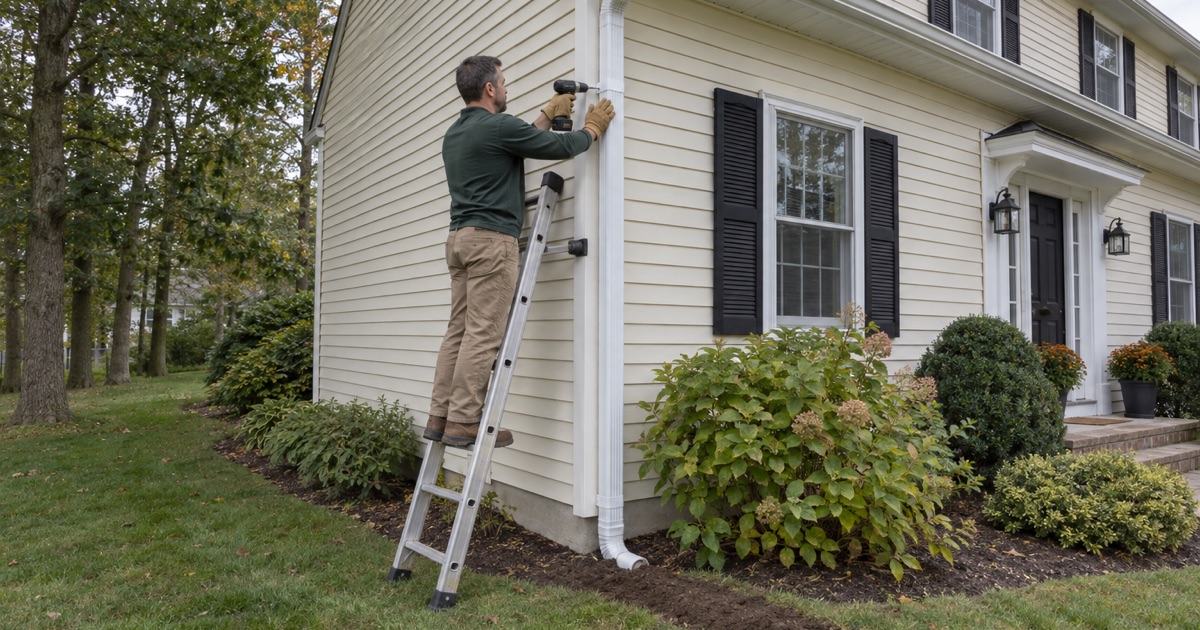
Many older houses have 2x3 downspouts, which carry less water and clog easily at the elbows when needles or leaves get in. On new installations we generally use 3x4 downspouts, which drain a gutter faster in a hard rain and pass small debris rather than trapping it. On 6-inch gutters, a 3x4 downspout is the standard pairing.
When only the downspouts are being replaced, we can usually fit 3x4 pipe to the existing gutter by cutting in a larger outlet, which gives an older system more capacity without replacing the gutter itself.
Wide-Flange Outlets
The outlet is the opening where water leaves the gutter and enters the downspout. A wide-flange outlet sits flush in the bottom of the gutter and funnels water into the pipe with less turbulence, so more water drains before the gutter fills. We use them on runs that carry heavy roof loads and on any gutter where an undersized outlet was causing overflow.
A and B Elbows and Secure Fastening
Downspouts turn corners using A and B elbows, which bend in two different directions to follow the wall and clear the gutter overhang. We choose the elbows that keep the downspout tight to the house and fasten it with straps at regular intervals, so it does not rattle in the wind or pull away from the outlet when someone leans a ladder against it.
Placing Downspouts Where the Water Can Go
Counting Downspouts From the Roof Area
Each downspout drains a share of the roof, and a long run or a large roof plane needs more than one. We measure the roof area feeding each gutter and place enough downspouts that none is overloaded in a heavy storm. A long eave usually gets one at each end, with the gutter pitched toward both.
Avoiding Walkways, Driveways and Patios
Where a downspout discharges matters as much as how many there are. Water dumped across a walkway freezes into an icy patch in winter, and water dumped onto a driveway that slopes toward the garage ends up inside. We place downspouts at corners where the water can be carried onto lawn or into a line, rather than wherever the gutter happens to end.
Grading Away From the Foundation
The New Jersey edition of the 2021 International Residential Code calls for the finished grade to fall 6 inches within the first 10 feet from the foundation (R401.3). A downspout emptying against a foundation without that fall puts roof water right back against the basement wall. We point out low spots near the house and route the downspout past them.
Extensions, Emitters and Underground Downspout Lines
Extensions and Splash Blocks
The simplest way to move water away from the house is a downspout extension, with a splash block to spread the flow and keep it from digging a hole. Extensions are inexpensive and effective where the yard slopes away from the house, though they can be in the way of mowing. Hinged extensions that flip up for lawn work are one way around that.
Underground Lines and Pop-Up Emitters
Where an extension would cross a walkway or the yard is flat near the house, we run an underground downspout line from the base of the downspout to a lower part of the yard. The line ends in a pop-up drainage emitter, which opens when water flows and closes when it stops. We slope the line steadily toward the emitter so it drains between storms.
Keeping Buried Lines Clear
Underground lines clog when leaves and needles wash down the downspout, which is why guards or regular cleaning matter more on a house with buried lines. On cleaning visits we flush every line and confirm that water comes out of the emitter. A line that backs up is cleared or, if crushed, replaced.
Drywells and Howell’s Drainage Rules
When a Drywell Makes Sense
A drywell is a buried chamber that holds roof water and lets it soak into the surrounding soil. It is the answer when there is nowhere on the surface to send a downspout, such as a small lot, a yard that slopes toward the house, or a spot where neighbors would get the water. New Jersey recognizes the drywell as a green infrastructure practice for groundwater recharge.
The 2-Foot Groundwater Separation
The state stormwater rule, N.J.A.C. 7:8, calls for a drywell to sit at least 2 feet above the seasonal high water table. On a lot with high groundwater, a drywell set too deep simply fills with water and stops draining. Howell’s plot plan requirements under Section 188-31 show the seasonal high water table and drainage swales for new construction, and we use what is known about your lot before proposing one.
No Drainage Into the Sanitary Sewer
Howell’s sewer rule, Township Code Section 252-21, makes it a violation to connect or discharge drainage into the sanitary sewer system. Every downspout we install, extend or reroute discharges to the ground, an emitter or a drywell, and the estimate says which, so there is never a question about where the water goes.
- 20+ Years in Business
- Seamless Gutters Formed On Site
- Before-and-After Photos