
Howell Gutters installs gutter guards in Howell, NJ, and has spent 20+ years keeping leaves out of gutters for homeowners serving surrounding cities including Ramtown, Freehold Township, Wall, West Freehold and Vista Center. The guard we recommend depends on what grows over your roof, because the debris that clogs a gutter under pitch pines is not the debris that clogs one under oaks.
That is the whole idea behind how we pick a guard. Before quoting, we walk the lot, look at which trees overhang which eaves, and check what is already sitting in the gutters. A house with pines out back and oaks along the front may get one type of guard on the rear eave and another in front, rather than a single product wrapped around the whole house.
We also check the gutters themselves before adding anything to them. A guard on a sagging, leaking or undersized gutter just covers a failing system, so if a run needs repair or replacement first, we tell you before you buy guards for it.
Gutter Guard Types We Install
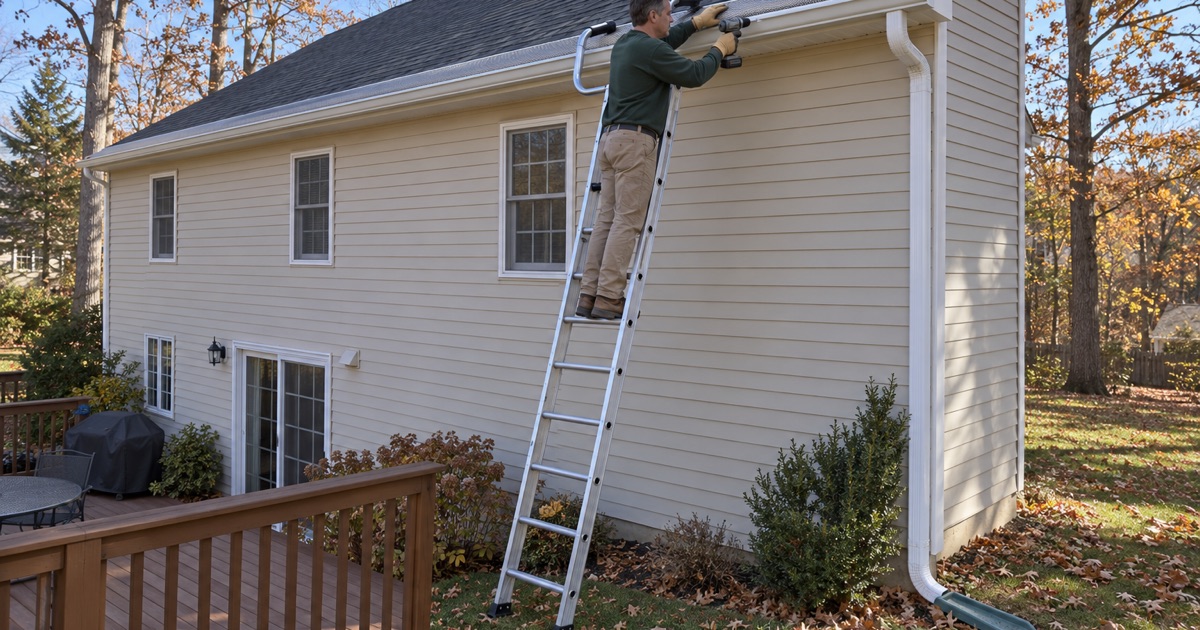
Stainless Steel Micro-Mesh Gutter Guards
Micro-mesh guards use a fine stainless steel screen stretched over a rigid frame. The openings are small enough to stop pine needles, shingle grit and most seeds while still letting rain pass through quickly. Stainless does not rust or sag, which matters on a guard expected to stay in place for many years.
This is the guard we recommend most often under conifers and on houses with heavy mixed canopy. It costs more than a basic screen, but it is the type that actually keeps needles out of the trough.
Perforated Aluminum Gutter Screens
Perforated screens are aluminum panels punched with holes or slots that clip over the gutter. They stop broad leaves well and cost less than micro-mesh, which makes them sensible on lots dominated by maples or oaks. Their weakness is fine debris; needles and seed pods can slip through the openings or lodge in them.
Hooded and Reverse-Curve Gutter Covers
Hooded covers close over the top of the gutter and rely on water following a curved front lip into a narrow slot, while leaves slide off the edge. They shed large debris and look clean from the ground. On steep roofs and in hard rain, water can run past the lip, and anything that does get into the slot is harder to clean out.
Some hooded systems are sold as a one-piece unit with the gutter itself, which means replacing the whole gutter to get the cover. We explain how a hooded cover compares with a micro-mesh guard on your particular roof pitch, so the choice is made on drainage rather than on appearance from the street.
Brush and Foam Gutter Inserts
Brush inserts are long bristle cylinders that sit in the trough, and foam inserts are porous blocks cut to fit the gutter. Both are cheap and quick to fit, and both trap debris rather than shedding it. They have a place on low-debris houses, but under real trees they become something else to pull out and clean.
Matching Gutter Guards to the Trees on Your Lot
Pitch Pine Needles
Pitch pine needles are stiff and narrow, and they drop through most of the year rather than in one fall burst. They pass through coarse screens and knit into tight mats in the outlet and downspout elbows, where water backs up behind them. Stainless micro-mesh is the guard that reliably keeps them on top, where they dry out and blow off the roof.
Oak Leaves and Acorns
Oak leaves are broad and leathery, and they arrive late in the fall in a heavy, wet layer. In an open gutter they compost into a dense sludge that holds water against the metal and weighs down the hangers. A sturdy screen or micro-mesh guard keeps them riding on top, and acorns roll off instead of collecting in the low spots of the trough.
Because oak leaves are large, they tend to collect in a loose blanket on top of the guard after a windy day. On most roofs that layer dries and blows away, but where an eave sits in a wind shadow beside a dormer or a second story, we point out the spot so it can be brushed off during a routine visit.
Maple Seeds, Blossoms and Pollen
Maple seeds, spring blossoms and pollen are small and light, so they settle on top of any guard. On a micro-mesh surface they sit loosely and wash or brush off. On a fine-slotted cover they can pack into the openings and slow the water down, which is why we look at spring debris as well as fall leaves when choosing a guard.
Fitting Guards to New or Existing Gutters
Checking the Gutters Before Guarding Them
We check that every run is fastened tight, pitched toward its outlet and sealed at the corners and end caps before fitting guards. A loose run is refastened on hidden hangers and a leaking miter is resealed with tripolymer gutter sealant, so the guard goes onto a gutter that drains properly.
If the gutter is undersized for its roof, we say so. Guards slightly reduce the speed at which water enters a gutter, so a 5-inch run already struggling in heavy rain may be better replaced with 6-inch seamless gutter before it is covered.
Setting Guards at the Roof Edge
The back edge of a guard has to meet the roof without lifting the shingles or blocking the drip edge. We fit guards that slide under or rest against the roof edge as the product is designed to, and fasten the front lip to the gutter so wind cannot peel the guard away. Set correctly, the guard follows the roof line instead of forming a ledge.
Protecting the Downspout Outlets
The outlet is where most clogs start, so we pay particular attention to the guard sitting above each downspout. Before the guards go on, we flush every downspout to confirm it runs clear, because a guard over a blocked outlet will simply overflow at that spot.
Living With Gutter Guards Year Round
Routine Care for Guarded Gutters
A guarded gutter still deserves a look once or twice a year. We brush off pollen and seed fluff, check that no guard has shifted, and run water through the downspouts. Each visit comes with before-and-after photos, so you can see the condition of the guards without climbing up yourself.
Gutter Guards, Snow and Ice
Ice dams come from heat escaping through the roof, not from guards, but snow and ice can sit on top of a guard once a dam forms. Guards that follow the roof line and stay fastened through winter hold up better than loose screens, which can be pushed out of place by sliding snow. If an eave builds ice every winter, the attic insulation and ventilation are where the lasting fix sits.
Keeping Out Birds, Seedlings and Standing Water
An open gutter full of debris gives birds a nesting ledge and gives seedlings enough soil to sprout. It also holds the standing water that Monmouth County Mosquito Control warns about. A properly fitted guard over a well-pitched gutter takes away all three, which is often the reason owners call about guards in the first place.
- 20+ Years in Business
- Seamless Gutters Formed On Site
- Before-and-After Photos